
History is not a record of what happened. It is a record of what survived.
Welcome, welcome.
If you’ve found your way here, you’ve probably already guessed this won’t be the kind of blog that stays on the surface. I’m a fairly lighthearted person in everyday life, but I’ve always been fascinated by the darker corners of history, the systems that shape civilizations, the stories people are taught to believe, and the truths that disappear beneath power, propaganda, and time. A lot of what I write, both in fiction and here, is rooted in that fascination.
Not everything is preserved, and what remains isn’t always neutral. History is recorded, protected, and retold through human hands, shaped by perspective, power, and intention. Over time, certain narratives are reinforced while others are buried, lost, or rewritten entirely, until the version we inherit feels complete, even when it isn’t.
I don’t write light stories. That probably sounds dramatic, especially if have ever met me in real life. I’m not a particularly serious person. I joke, I ramble, and I am not walking around giving speeches about truth and power over coffee. It’s not that these thoughts aren’t always in my head, but for many, they’re just not conversations they’re willing to have.
But when I sit down to write, something shifts. The tone changes because the ideas I’m working with are not abstract to me. They are grounded in history, in patterns that repeat, and in the quiet ways the truth can be altered without most people ever realizing it.
My background is in anthropology, which means I have spent a lot of time looking at how cultures record, preserve, and sometimes (often times) lose their histories. Not just through time, but through force. War destroys records, empires reshape narratives, and those in power influence what is remembered and what disappears quietly. Once something is erased, it doesn’t always come back, and what replaces it often carries the authority of truth simply because it is the only version that remains.
We tend to think of propaganda as something obvious or extreme, something loud enough that we would recognize it immediately. Most of the time, that simply isn’t the case. Propaganda is often subtle, reinforcing what people already believe or narrowing what they are willing to question. It shames the frame before anyone realizes there is a frame at all, which makes it far more effective than anything overt.
And this isn’t new. A lot of people think in the age of the internet and social media that propaganda is this new phenomenon, only taking over because the ability to spread information is so simple now. That is not the case.
Revisionism has existed for thousands of years. Ancient rulers commissioned official histories that justified their actions and solidified their authority, ensuring that events were recorded in was that maintained power and legitimacy. We can look to Ancient Egypt to see one of the clearest examples of this. Pharaohs routinely controlled how history was recorded. Hatshepsut’s successor, Thutmose III, attempted to erase her from history by defacing monuments and removing her name from inscriptions after her death in order to emphasize an unbroken male lineage. Thutmose III was successful in her pursuit until Jean-François Champollion deciphered hieroglyphs at Deir el-Bahri in the 19th century.
Ancient Rome practically perfected state-sponsored revisionism. Emperors used damnatio memoriae–a formal process for erasing someone from history. Names were scratched out, statues destroyed, and records were altered to make it seem as though a person never existed. At the same time, rulers like Augustus curated their legacy through both text and imagery. In the Res Gestae, Augustus presents his reign as benevolent and necessary, leaving out the political manipulation that brought him to power, while monuments like Ara Pacis Augustae (Altar of Augustan Peace) reinforced that narrative by portrating him as a pious, peace-bringing restorer of Rome rather than the ruthless warlord he had been.
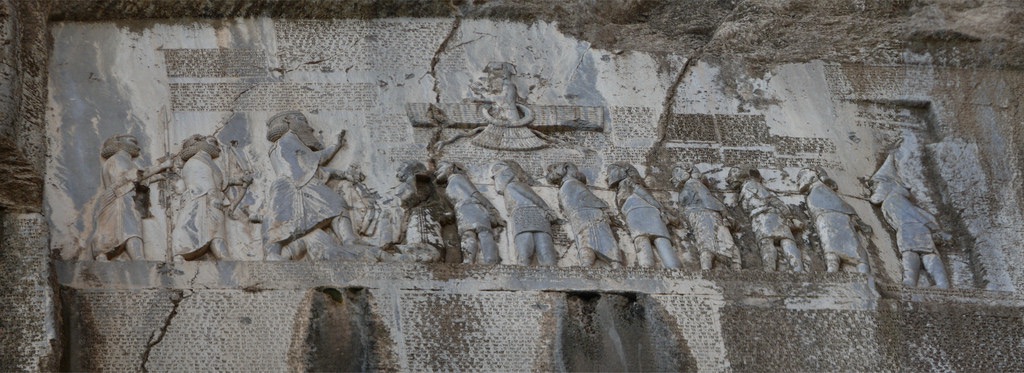
We can look to the Qin Dynasty of China or the Neo-Assyrian empire to find even more evidence of this. Truly, I could go on and on about revisionism in the history of civilization. Or the Achaemenid Empire with the Behistun Inscription of Darius I. The inscription is the story of how Darius I came to power, in which he frames himself as the rightful ruler and labels his rivals liars and rebels. Many scholars argue that Darius I himself killed the real Bardiya (or facilitated it) and created the imposter story to gain legitimacy, making his official narrative a massive political falsehood. To many, the Behistun Inscription is essentially a public, permanent version of “history written by the winner,” carved into a mountainside for everyone to see. Truly I could go on and on about revisionism in the history of civilization.
By the time we reach World War I and World War II, propaganda had been refined into something far more systematic. With the rise of mass media, governments were able to influence public opinion at scale, shaping not only how events were understood in the moment but how they would be remembered long after.
Scholars like Edward Bernays examined how public perception could be shaped and directed. He demonstrated that shaping belief no longer required rewriting the past–it could be done in the present. Drawing on the psychological insights of Sigmund Freud, he crafted campaigns that tied products and ideas to identity, emotion, and social meaning rather than fact. His work revealed something far more unsettling: truth doesn’t need to be buried if it can be outperformed.
Later words, such as Manufacturing Consent: The Political Economy of Mass Media by Esward S. Herman and Noam Chomsky explored how institutions filter and construct the information people receive. The result is a version of reality that feels coherent and complete, even when it has been carefully curated and isn’t entirely truthful.
That is the idea at the center of every story I write, staring back at me every time I sit down to write.
What happens when someone begins to realize that the version of the world they trust is incomplete? Not through a single dramatic revelation, but through small inconsistencies that start to accumulate. A contradiction that doesn’t quite make sense. A detail that doesn’t fit. A story that feels just slightly off in a way that is difficult to ignore.
When you’ve been taught your entire life not to question it. When you’ve never once before even thought to question it. Even when you believed in it with every fiber of your being, when it is engrained in who you are as a person.
That tension between what is true and what is told is where my stories live. Not because I think I have the answers, but because I am interested in the moment when that belief starts to fracture. Once that fracture begins, it comes impossible to return to the version of the world that existed before, no matter how much easier it might be to accept it.
If you are here, you are probably the kind of reader (person) who notices those fractures. The ones who question things a little longer than most people, who aren’t satisfied with the surface version of events. Who understands that truth and narrative are not always (and not often) the same thing.
That is where all of this begins.
Until next time,
-N.A. Keller
 nakeller.org
Leave a comment